

“Some of the most successful former students I know were not the highest achievers academically,” says Kirsten Prescott, Head of Secondary at Regent’s International School Bangkok. “What they possessed was self-awareness, resilience, adaptability, strong relationships and a sense of purpose.”
It is a striking way to begin a conversation about success, and it sits at the heart of how the school thinks about every child in its care. Looking beyond academic success does not mean valuing it less. It means recognising that children succeed in different ways, and that a good school helps each of them find their own. This is the thinking behind personalised learning in international schools, and at Regent’s International School Bangkok, it describes a genuine belief rather than a slogan.
A wider definition of success
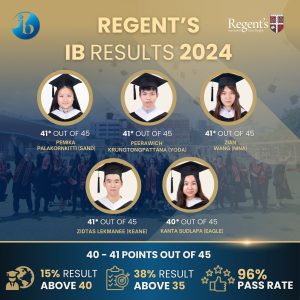
This does not mean academic results matter less. For results-focused families, reassurance is important. Kirsten is clear that strong qualifications remain central. “We want students to leave us with excellent qualifications,” she says, “but we also want them to leave with character, confidence and a genuine sense of possibility.”
Success, in this view, is not a single finish line that every child crosses in the same way. It is the point at which a student becomes the most capable version of themselves, equipped with both the grades and the personal qualities to build a future. This is what moving beyond academic success really means. It is not setting results aside but refusing to treat them as the only measure that counts, especially in an international school in Bangkok where pathways are increasingly diverse.
Pathways built around the individual
A child-centred education is only credible if the school is structured to deliver it. At Regent’s, that structure is visible in the range of pathways on offer. Some students thrive in highly academic settings, while others flourish through applied, creative or leadership-focused routes, supporting every child’s strengths.
In the sixth form, students can choose between the full IB Diploma and a Regent’s High School Diploma, a more personalised pathway designed for students whose ambitions lie elsewhere. Because that choice exists, a young musician or artist is not pushed down a route that does not suit them. In the last two graduating classes, two talented musicians, neither of whom followed the full IB Diploma, went on to places at the Royal College of Music in London and Berklee College of Music in Boston. Alongside these pathways, students are supported by pastoral systems, learning support, English language support and careers guidance, all designed to support a child-centred education and help each student reach their potential.
Creating the conditions for discovery
Helping your child reach their potential depends on giving them the chance to discover where it lies. “Young people cannot discover talents they have never been given the opportunity to explore,” Kirsten says. That is why breadth matters, across sport, music, drama, technology, service and leadership.
The moment of discovery is often recognisable. A student becomes more confident, begins to take risks and starts to believe in themselves. As Kirsten describes it, they move from asking “Can I do this?” to asking “What else can I do?” Supporting every child’s strengths begins with making sure there are enough doors for them to try.
What success can look like
One student captures this well. They arrived lacking confidence and struggling to find their place. Their academic work was diligent, but examinations were never likely to be their defining strength. Over time, they took on leadership responsibilities, joined service projects and supported younger pupils, gradually finding confidence they had not known they had. By the time they left, others looked up to them.
“Their grades were respectable,” Kirsten says, “but what mattered most was the person they had become.”
For families weighing up an international school in Bangkok, the reassuring truth is that personalised learning and academic rigour are not in tension. A school can hold students to high standards while recognising that they will reach those standards by different routes and leave with different strengths. That balance, of excellent qualifications alongside real character and confidence, is what Regent’s International School Bangkok personalised learning is built to provide. Parents who would like to understand how it works for their own child are warmly welcome to continue the conversation with us.